

How Split de Pagamento works
Learn more about the split and fee application models.
Split de Pagamento operates on two fee levels:
- First level: The commission set by the master for its sellers.
- Second level: The service fees charged by Cielo to the master.
The solution automates calculation and distribution at both levels.
On this page, you will learn the key concepts of Split de Pagamento: the participants involved, the split models, and how fees are applied.
Participants: master and seller
Split de Pagamento involves at least two roles. It is essential to understand the function of each:
| Participant | Definition | Role |
|---|---|---|
| Master | It is the owner of the main business, who hires the Split and manages the sellers. |
|
| Seller | It is the partner merchant that sells its products or services through the master. |
|
How many participants can a sale have?A transaction can include the following participants:
- Only the master (no split);
- The master and one or more sellers (with split).
Types of fees
Split de Pagamento works with two types of fees to compose the commission. Both are defined between Split de Pagamento and the master, and between the master and the seller.
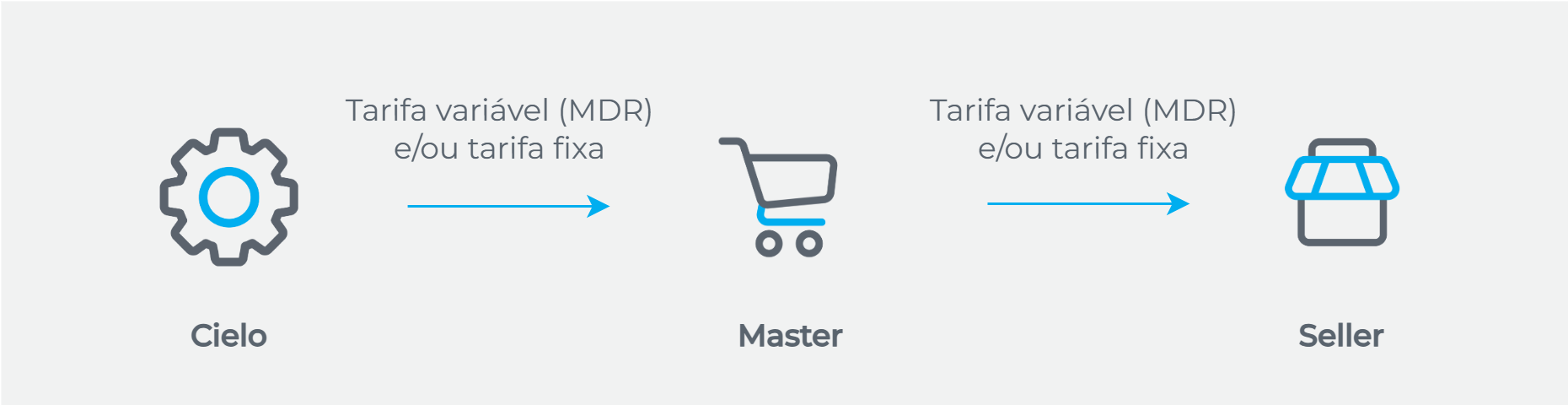
Variable fee (%)
Also known as Merchant Discount Rate (MDR), it is a percentage deducted from each seller’s sale amount.
You can choose:
- Global variable fee: apply the same discount percentage to all transactions, regardless of the payment method;
- Variable fee for each payment arrangement: set the discount you want to apply for each payment method, card brand, and installment plan.
Fee configuration
- For Pix and boleto, you can set a standard fee;
- For debit cards, you can choose different fees for each card brand;
- For credit cards, you can choose different fees for each card brand and number of installments.
The variable fee is the main component of the split. The amount allocated to the master (its commission) must already include the MDR negotiated with Cielo.
Fixed fee (R$)
Also called transactional fee, it is a fixed amount in cents charged per captured transaction.
Unlike the variable fee, the fixed fee is not part of the split calculation. It is debited directly from the master’s and seller’s financial schedule after the split has been calculated.
Split models: when fees are defined
The flexibility of Split de Pagamento lies in the different moments when the split can be set. Choose the model that best fits your business rule*:
| Model | When fees are defined | Ideal for |
|---|---|---|
| Pre-configured split | Before the transaction | Businesses with fixed and standardized fees for each seller, applied to all sales. |
| Transactional split | During the transaction | Scenarios where fees change for each sale, such as promotions or carts with products from different categories. |
| Post-transactional split | After the transaction | Cases that require an adjustment or redistribution of the amount after payment confirmation. Redistribution must be done by 01:00 AM the next day after capture. |
*Check the model available for the desired capture solution (e-commerce or POS terminal).
Where to configure fees
| Model | Where to configure | How it works |
|---|---|---|
| Preconfigured Split – applies to all sales | E-commerce Portal or API |
|
| Transactional Split – configured for each sale | API |
|
| Post-transactional Split - configured for each sale | E-commerce portal or API |
|
The only difference between the physical world and e-commerce is in the transactional split. Preconfigured and post-transaction splits are set up the same way.
Displaying fees in the financial schedule
There is a difference in how fees are applied:
- The fixed fee is applied when the financial schedule is created, so it appears in the schedule.
- The variable fee is applied when the transaction is split and therefore does not appear in the financial schedule.
Practical example: money flow
Let’s illustrate how the split works in a credit sale of R$ 100.00, involving the master and seller A.
Fee agreements:
- Agreement master ↔ seller A:
- Variable fee (MDR): 4.0%
- Fixed fee: R$ 0.30
- Agreement Cielo ↔ master:
- Variable fee (MDR): 2.0%
- Fixed fee: R$ 0.10
The calculation is as follows:
1. Variable fee (MDR) calculation:
- The seller’s MDR amount is calculated on the total:
**R$ 100.00 \* 4.0% = R$ 4.00**. - Of the
R$ 4.00,**R$ 2.00 (2%)**is the master’s cost with Cielo, and the otherR$ 2.00is the master’s profit on the transaction.
2. Amount split (receivables):
- Seller A will receive:
R$ 100.00(sale) -R$ 4.00(MDR) =R$ 96.00R$ 96.00-R$ 0.30(fixed fee) =R$ 95.70
Seller A will receiveR$ 95.70.
- Master will receive:
R$ 2.00(MDR profit) +R$ 0.30(seller’s fixed fee) =R$ 2.30R$ 2.30-R$ 0.10(Cielo fixed fee cost) =R$ 2.20
Master will receiveR$ 2.20.
- Cielo will receive:
R$ 2.00(master’s MDR cost) +R$ 0.10(master’s fixed fee cost) =R$ 2.10
Cielo will receiveR$ 2.10.
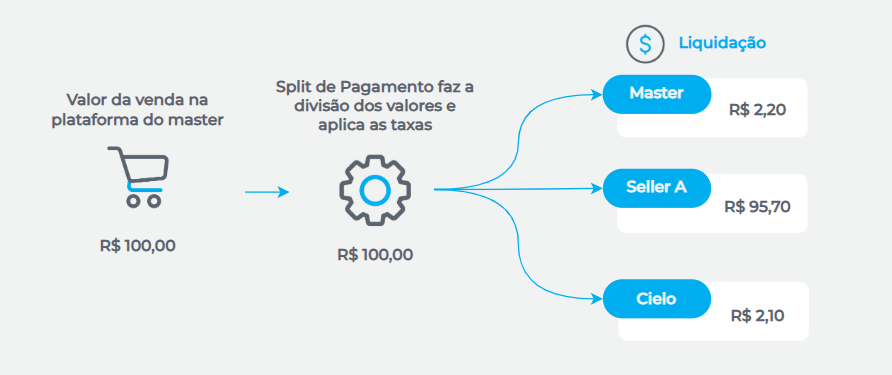
Division of amounts among participants after applying the fees.
Updated 5 months ago